The neighborhoods around the avenue corridor and the older town grids run plumbing from another era — galvanized steel lines that have been corroding quietly since before some of their owners were born. Galvanized pipe fails from the inside: zinc coating erodes, iron rusts, the bore narrows, and the wall thins until one ordinary Tuesday it opens up at full pressure. The good news: corrosion announces itself for months before the burst, if you know the language. Here are the seven signs.
1. Water that runs brown in the morning
Rust-colored water on the first draw of the day — clearing after a few seconds — is corrosion shedding overnight into standing water in the line. It’s not a city-water problem; it’s your pipe interior exfoliating. Every morning it happens, the wall is thinner than the morning before.
2. Pressure that’s quietly declined
Galvanized corrosion narrows the bore from the inside — a pipe that delivered a strong shower in 2015 and a tired one today is usually clogging, not failing at the faucet. Gradual pressure loss across the whole house points at the main runs; at one fixture, the branch. Either way, narrowing pipes and thinning walls are the same disease.
3. The rust ring at fittings
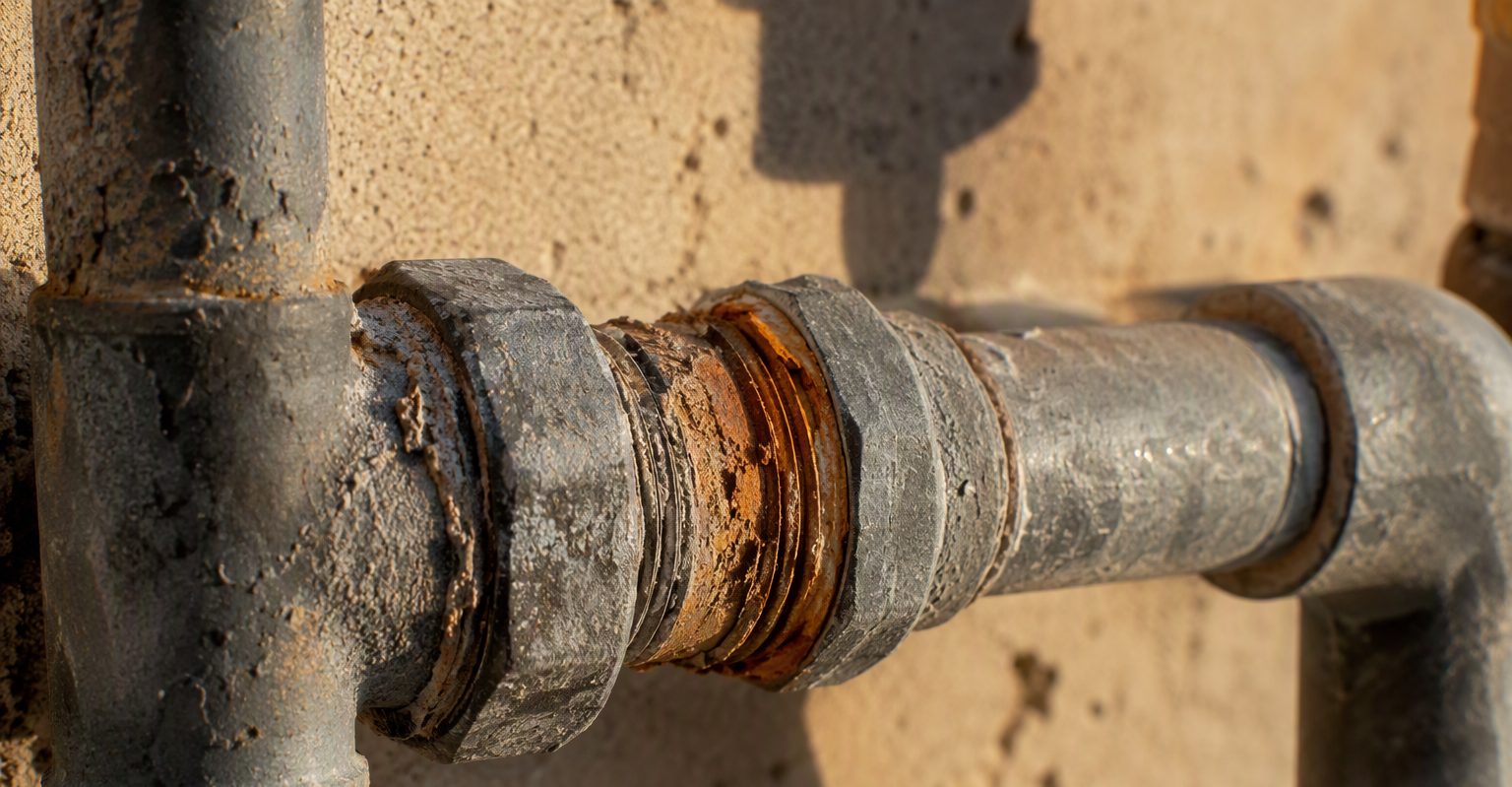
A faint rust halo on a valve body or threaded fitting means it has been weeping — not leaking, weeping — long enough to corrode. Corrosion doesn’t stabilize; it progresses. A weeping fitting is a burst fitting with a future date on it, and the date is always sooner than the homeowner assumes.
4. Flaking or dimpling on exposed pipe
Check the runs you can see — garage, water heater closet, under sinks. Galvanized pipe that shows white oxidation crust, rust dimples, or flaking at the threads is showing you its remaining life on the outside of the wall. What’s inside the wall looks worse, not better.
5. The pinhole that “fixed itself”
A pinhole leak that sealed over with mineral crust isn’t healed — it’s a weak spot the water found first, paused. Pinholes cluster on the same corroded stretch. One pinhole means the pipe section is done; the only question is how many rooms get wet on the day the next one opens.
6. The water heater’s confession corner
Garage water heaters in this valley live brutal lives — 140-degree ambient heat all summer, hard desert water settling sediment in the tank. Moisture or rust streaks at the base, a damp or mineral-stained T&P discharge line, rumbling from sediment: a tank at year ten in a Yuma garage is on borrowed time, and tank failures don’t leak — they empty.
7. The meter that never stops
Your water meter is the simplest leak detector ever made: shut every fixture, then watch the low-flow indicator for ten minutes. If it moves, water is going somewhere — inside a wall, under the slab, or into the yard line. Slab leaks in particular love to run for months, heating one mysterious warm spot on the floor and inflating the bill a few dollars at a time.
Found a sign? The order of operations
Don’t tighten, tape, or hope — a disturbed weeping fitting often becomes an open failure. Shut the local valve (or the main), photograph what you found, and call. If it’s already burst: main off, breaker to any wet room, photos, call — in that order. Corroded pipe doesn’t get better; it gets scheduled. The choice is whether the schedule is yours or the pipe’s.